
One chicken wing has about 99 calories when it’s plain, roasted, and still has the skin on. That’s a reasonable starting point – but it’s rarely the whole story. The moment you add frying, breading, sauce, or a side of ranch, those numbers shift fast. An order of 10 restaurant-style wings can land anywhere from 1,000 to nearly 2,000 calories depending on how they’re made.
This guide breaks down every variable that matters: cooking method, skin, sauce, serving size, and more. By the end, you’ll have exact numbers to work with and a clear picture of where the calories actually come from.
How Many Calories Are in One Chicken Wing?
A single plain, roasted, skin-on chicken wing averages about 99 calories. That figure refers to one piece – either a drumette (the meaty part shaped like a tiny drumstick) or a flat (the middle section with two thin bones). When a restaurant says “10 wings,” they typically mean 10 individual pieces, not 10 whole wings. Whole wings have three parts, so two whole wings would produce six pieces once tips are removed.
Wing size also matters. A small wing from a grocery store package might weigh 40 grams cooked. A jumbo commercial wing at a sports bar might weigh 80 grams. That’s a difference of roughly 50 to 60 calories per piece – which adds up quickly across a full order.
The 99-calorie baseline assumes no sauce, no breading, and skin intact after roasting. From there, every variable either adds or subtracts.
Calories by Serving Size
The table below uses plain roasted, skin-on wings at approximately 99 calories per piece. No sauce, no breading.
| Serving Size | Calories |
|---|---|
| 1 wing | 99 |
| 2 wings | 198 |
| 3 wings | 297 |
| 5 wings | 495 |
| 6 wings | 594 |
| 8 wings | 792 |
| 10 wings | 990 |
| 12 wings | 1,188 |
These numbers represent the floor, not the ceiling. In real-life eating situations – restaurant-style fried wings with buffalo sauce – expect 120 to 150 calories per piece. An order of 10 wings from a major chain, before any dip, often falls between 1,200 and 1,500 calories. Add a side of blue cheese and a basket of fries, and a wing night can easily exceed 2,000 calories.
Calories per 100g of Chicken Wings
For anyone tracking by weight rather than piece count, raw and cooked wings give very different numbers per 100 grams.
Raw chicken wing with skin: approximately 203 calories per 100g. Roasted chicken wing with skin: approximately 290 calories per 100g.
The total calories in the food haven’t changed between raw and cooked. Cooking drives out water, which concentrates everything into a smaller total weight. A 100-gram raw wing might cook down to 70 grams – those 70 grams now contain the same calories as the original 100 grams did.
For accurate tracking, weigh wings after cooking and use cooked-weight values. Using raw-weight numbers on food that’s already been cooked leads to underestimates.
Skin-On vs Skinless Wings
Removing the skin cuts wing calories by roughly 30 percent. A skin-on roasted wing averages 99 calories. The same wing without skin drops to about 64 to 70 calories. The difference is almost entirely fat – chicken skin is dense with it. Protein content remains nearly the same whether the skin is on or off.
Most restaurant wings arrive with the skin on, and it’s usually crisped into the part people enjoy most. At home, though, removing the skin after cooking – once it’s already kept the meat moist – is the single fastest way to reduce calories without eating less food.
Raw vs Cooked Chicken Wings
This distinction trips people up more than almost any other factor in calorie tracking.
Raw wings weigh more because they hold water. Once cooked, that water evaporates and the wing becomes lighter and denser. A wing that weighs 95 grams raw might weigh 68 grams after roasting. The calorie totals are identical – but if you weigh that 68-gram cooked wing and mistakenly look up nutrition values for 68 grams of raw wing, you’ll undercount by 30 percent or more.
Always match weight to state. Weigh raw wings and use raw values, or weigh cooked wings and use cooked values. Mixing the two gives inaccurate results.
Calories by Cooking Method
How you apply heat – and whether any fat is added along the way – is one of the biggest variables in wing calories.
| Cooking Method | Calories per Wing (Approx.) |
|---|---|
| Grilled | 90–100 |
| Smoked | 95–105 |
| Air-fried | 95–110 |
| Baked | 100–115 |
| Deep-fried | 125–145 |
Grilling and smoking both allow fat to drip away from the meat as it cooks, keeping the calorie count close to the natural baseline. Wings cooked this way often end up on the lower end of the range, especially if no butter or oil is added before cooking.
Baking produces similar results, particularly when wings are placed on a wire rack over a sheet pan. The rack lets rendered fat drip down instead of pooling around the meat and reabsorbing. Baked wings without any oil or breading sit firmly in the 100 to 115 calorie range per piece.
Air-frying delivers a crispy exterior very close to deep-frying but uses little or no added oil. The calorie difference between air-fried and baked wings is small – usually 5 to 15 calories per piece – which is why air-fryers have become popular for lower-calorie cooking.
Deep-frying adds the most calories because wings absorb frying oil during cooking. Even at high temperatures that cook the surface fast, wings still pick up meaningful fat. This typically adds 25 to 45 extra calories per wing compared to baked.
Plain Wings vs Breaded Wings
Standard chicken wings have no coating beyond their natural skin. Breaded wings are covered in seasoned flour, a batter, or a breadcrumb mixture before cooking. That coating adds calories even before any sauce is applied.
A plain skin-on wing roasted to order: around 99 to 115 calories. A breaded, deep-fried wing of the same size: approximately 140 to 170 calories. The coating adds carbohydrates and absorbs more frying oil, which accounts for the increase.
At restaurants, wings labeled “crispy” or “extra crispy” are almost always breaded. “Naked wings” or “traditional wings” refer to unbreaded versions. Asking for traditional or naked wings is a simple step that saves 30 to 50 calories per piece without sacrificing flavor.
Boneless vs Traditional Wings
Despite the name, boneless wings are not the same as traditional chicken wings. They’re typically made from breast meat, cut or formed into small pieces, then breaded and fried to mimic the look of a wing. Think of them as chicken nuggets shaped differently.
A traditional bone-in wing, roasted with skin: ~99 calories per piece. A boneless wing, breaded and fried: ~120 to 150 calories per piece.
Boneless wings tend to run higher in calories for two reasons. First, they’re almost always breaded and fried – you rarely see a plain baked boneless wing on a menu. Second, the coating-to-meat ratio is higher because the pieces are smaller. For anyone counting calories, bone-in traditional wings prepared simply are usually the better choice.
How Sauces Change the Calorie Count
Sauce is one of the most underestimated sources of calories in any wing order. Some sauces are genuinely light. Others add more calories per wing than the cooking method does.
| Sauce | Calories Added per Wing (Approx.) |
|---|---|
| Buffalo (classic) | 10–30 |
| Sweet chili | 25–40 |
| Teriyaki | 30–45 |
| BBQ | 30–45 |
| Honey garlic | 35–50 |
| Garlic Parmesan | 45–75 |
Buffalo sauce earns its reputation as the lighter option. Classic buffalo is made primarily from cayenne-based hot sauce and butter, applied as a thin coating. At most restaurants, this adds roughly 15 to 30 calories per wing – modest compared to other options.
Garlic Parmesan is the heaviest choice on this list. The sauce is typically made with butter, olive oil, garlic, and Parmesan cheese, then applied generously. Some restaurant versions add 60 to 75 calories per wing. Across an order of 10 wings, that’s an additional 600 to 750 calories from the sauce alone.
BBQ and honey garlic sit in the middle of the range. Both are sugar-forward, and sugar adds up across a full serving. An order coated in honey garlic sauce carries 350 to 500 more calories than the same wings served plain. Teriyaki has a comparable sugar load and also brings significantly more sodium.
The dipping sauces on the side deserve attention too. Two tablespoons of blue cheese dressing adds 130 to 160 calories. Ranch dressing is similar. If you dip every wing, you could easily add another 300 to 400 calories to your total.
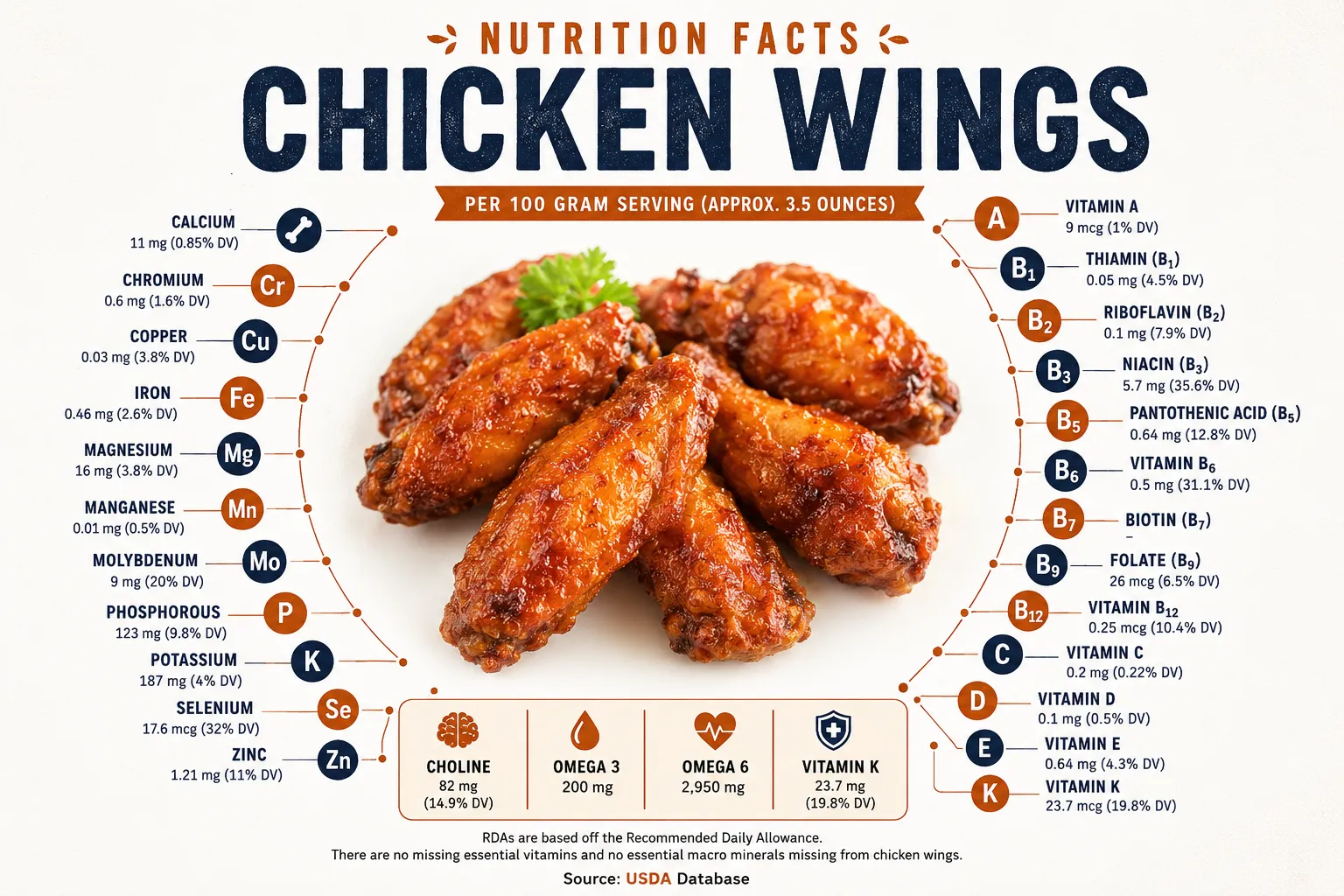
Full Nutrition Facts for Chicken Wings
Here’s what you get from plain roasted, skin-on chicken wings per 100 grams of cooked meat.
| Nutrient | Per 100g (Roasted, Skin-On) |
|---|---|
| Calories | 290 |
| Protein | 27g |
| Total fat | 19.5g |
| Saturated fat | 5.4g |
| Carbohydrates | 0g |
| Cholesterol | 90mg |
| Sodium | 85mg |
| Iron | 1.2mg |
| Zinc | 2.3mg |
| Vitamin B12 | 0.3mcg |
| Niacin (B3) | 7.6mg |
| Phosphorus | 170mg |
Plain wings deliver 27 grams of complete protein per 100 grams cooked – all essential amino acids included. They’re also a solid source of B vitamins, particularly niacin and B12, both of which support energy metabolism and nerve function. Zinc supports immune health. Phosphorus plays a role in bone strength. On paper, the nutrient profile is genuinely decent.
The fat content is real and concentrated in the skin. Removing the skin changes things considerably – skinless roasted wings drop to around 8 to 10 grams of fat per 100 grams cooked.
Macronutrient Comparison by Wing Type
| Wing Type | Protein (per 100g) | Fat (per 100g) | Carbs (per 100g) |
|---|---|---|---|
| Skin-on, roasted | 27g | 19.5g | 0g |
| Skinless, roasted | 28g | 8g | 0g |
| Deep-fried, skin-on | 25g | 23g | 4g |
| Breaded and fried | 22g | 18g | 12g |
| With buffalo sauce | 27g | 21g | 1g |
| With BBQ sauce | 27g | 19.5g | 8g |
Breaded and fried wings shift the macronutrient balance by adding carbohydrates from the coating and extra fat from frying. Plain wings in any form – roasted, grilled, or air-fried – stay at essentially zero carbohydrates, which makes them a natural fit for low-carb eating patterns.
Are Chicken Wings Healthy?
It depends heavily on preparation and portion size.
Plain chicken wings offer real nutritional value. A 100-gram portion gives you 27 grams of protein alongside meaningful vitamins and minerals. The zero-carb profile suits several dietary approaches. From a macronutrient standpoint, that’s a reasonable package.
The complications arrive with cooking choices and additions. Deep-frying adds fat. Heavy, sweet sauces add sugar and sodium. Eat a full order of fried, sauced wings with a generous dip and some bread, and you can take in more calories in one meal than many people need in an entire day.
Wings are also higher in saturated fat compared to leaner cuts like chicken breast or skinless thigh, which is worth noting for anyone monitoring cardiovascular health. The American Heart Association recommends limiting saturated fat intake, and wings with skin – particularly fried ones – deliver a meaningful amount.
The honest take: wings are not a junk food in disguise, but they’re also not health food by default. How you cook them and how many you eat determines which side of that line they fall on.
Are Chicken Wings Good for Weight Loss?
They can be, but context matters a great deal.
Plain baked or grilled wings are a legitimate high-protein option for people managing their weight. A serving of six plain baked wings provides roughly 25 to 30 grams of protein at around 600 calories. Protein is the most satiating macronutrient – it reduces hunger more effectively than an equivalent number of calories from carbohydrates or fat. That makes wings more filling per calorie than many other snack or appetizer options.
The challenge is that wings are almost never eaten plain and baked. In restaurant settings, they arrive fried, sauced, and accompanied by calorie-dense dipping sauces and sides. That context makes calorie control difficult without deliberate choices about what to order and how much to eat.
At home, wings prepared in an air-fryer or oven with a light sauce are perfectly compatible with weight loss goals. Order the same style at a sports bar and the numbers change significantly. The food isn’t different – the preparation and portions are.
Tips to Make Chicken Wings Lower in Calories
Small adjustments compound across a full serving. These are the most effective ones.
Use a wire rack when baking. Placing wings on a rack set over a foil-lined pan lets rendered fat drip away from the meat instead of pooling underneath. It also promotes even air circulation, which helps skin crisp up without any added oil.
Air-fry instead of deep-fry. Air-fryers produce results remarkably close to deep-frying – genuinely crispy skin — at a fraction of the added fat. The calorie saving runs 25 to 45 calories per wing, which is about 250 to 450 calories across a 10-piece order.
Remove the skin after cooking. Leaving the skin on during cooking helps the meat stay moist. Pulling it off before eating captures much of that benefit while eliminating most of the fat. The skin also carries sauce, so peeling it post-sauce is less effective, but pre-sauce it works well.
Make sauce at home. Restaurant sauces are applied generously and made with commercial quantities of butter and oil. A homemade buffalo sauce using a quality hot sauce, a small amount of butter, and a splash of vinegar delivers the same flavor profile at roughly half the calories per wing.
Choose the right dip. Blue cheese and ranch each add over 100 calories per tablespoon-sized dip. Straight hot sauce has near-zero calories. A quick pickle brine or a yogurt-based dip are lower-calorie alternatives that still add contrast.
Control portion with intention. Wings arrive in groups and are eaten one at a time, which makes it easy to lose track of how many you’ve had. Serving yourself a defined number before starting – rather than grazing from a shared plate – helps a lot.
Restaurant Wings vs Homemade Wings
The gap is usually larger than people expect, and it shows up in multiple places at once.
Restaurant wings tend to be larger than grocery store wings, fried in well-seasoned oil, sauced heavily, and often pre-seasoned before cooking. A single wing piece at a popular chain can weigh 70 to 90 grams rather than the 50 to 60 grams typical of a home cook’s wing. Before sauce, that size difference alone adds 30 to 50 calories per piece.
Deep-frying is standard at most restaurants, even for wings ordered “crispy baked.” Add sauce and the per-wing count often lands between 140 and 200 calories. Some chains publish nutrition information showing specific menu items exceeding 200 calories per wing after sauce.
An order of 10 restaurant wings with sauce frequently totals 1,400 to 1,600 calories before dipping sauce. A 10-piece homemade order – baked on a rack, seasoned with salt and pepper, finished with a light buffalo sauce – more typically lands between 1,000 and 1,150 calories for the same number of pieces.
The primary advantages of cooking at home are portion precision and ingredient control. You can weigh your wings, measure your sauce, and know exactly what you’re working with.
Common Mistakes When Estimating Wing Calories
People consistently undercount wing calories, often significantly. These are the most common reasons why.
Counting whole wings instead of pieces. Many people picture a “wing” as a full single unit. On menus, “10 wings” almost universally means 10 pieces – 10 drumettes or 10 flats or a mix of both. Assuming otherwise cuts your mental count in half.
Ignoring the sauce. Someone might accurately track the calorie count of a serving of fried wings but forget to add anything for the honey garlic sauce coating every piece. At 40 to 50 calories per wing, that’s 400 to 500 unaccounted calories in a 10-piece order.
Forgetting the dip. One small container of blue cheese dressing brought to the table can hold two to three tablespoons – anywhere from 150 to 300 calories – and it’s easy to use without registering it mentally as part of the meal.
Using raw weight values for cooked wings. Cooked wings are denser than raw wings by about 30 percent. Looking up “chicken wing, 70g” for a wing that weighed 70 grams after cooking but 100 grams raw means you’re using the wrong row of the nutrition table.
Assuming all wings are the same size. A “wing” at a fast-casual restaurant might weigh 45 grams. A “wing” at a sports bar known for its giant portions might weigh 85 grams. Per-wing calorie averages don’t hold across every kitchen.
Frequently Asked Questions
How many calories are in 6 chicken wings?
Six plain roasted, skin-on wings contain approximately 594 calories. Six restaurant-style fried wings with sauce typically land between 750 and 950 calories depending on size and sauce.
How many calories are in 10 chicken wings?
Ten plain roasted, skin-on wings average around 990 calories. Ten restaurant-style fried wings with a medium-sugar sauce like BBQ or honey garlic typically range from 1,300 to 1,600 calories.
Are wings high in calories?
Wings are moderately calorie-dense, mostly because of the skin and cooking fat. A plain baked wing sits around 100 calories, which is reasonable given the protein it provides. The count rises meaningfully with frying, breading, and heavy sauce.
What is the lowest-calorie way to eat chicken wings?
Grilled or baked, skinless, with plain hot sauce or no sauce. A wing prepared this way averages 60 to 80 calories while still delivering high-quality protein.
Are boneless wings healthier than regular wings?
Not necessarily. Boneless wings are almost always breaded and fried, which makes them higher in carbohydrates and often comparable in total calories to traditional fried wings. Traditional bone-in wings cooked simply tend to be the lighter choice.
How many calories does blue cheese dressing add?
About 130 to 160 calories per two-tablespoon serving. If you’re using it as a dip throughout a full order, the total addition can easily reach 300 to 400 calories.
How much protein is in 10 chicken wings?
Ten plain roasted, skin-on wings provide roughly 55 to 65 grams of protein. Exact amounts vary by wing size and cooking method, but wings are a reliably good source of protein in any preparation.
Do restaurant wings always have more calories than homemade?
In almost every case, yes. Restaurants use larger wings, commercial fryers, and heavier sauce applications. Homemade wings baked or air-fried with a measured sauce consistently come in lower, often by 20 to 40 percent per piece.